Cosmetic Dentistry
Does Invisalign Hurt? What to Expect with Aligners
Mild pressure rather than sharp pain — that is the honest description. Here is what to expect tray by tray, and how to manage the discomfort from day one.
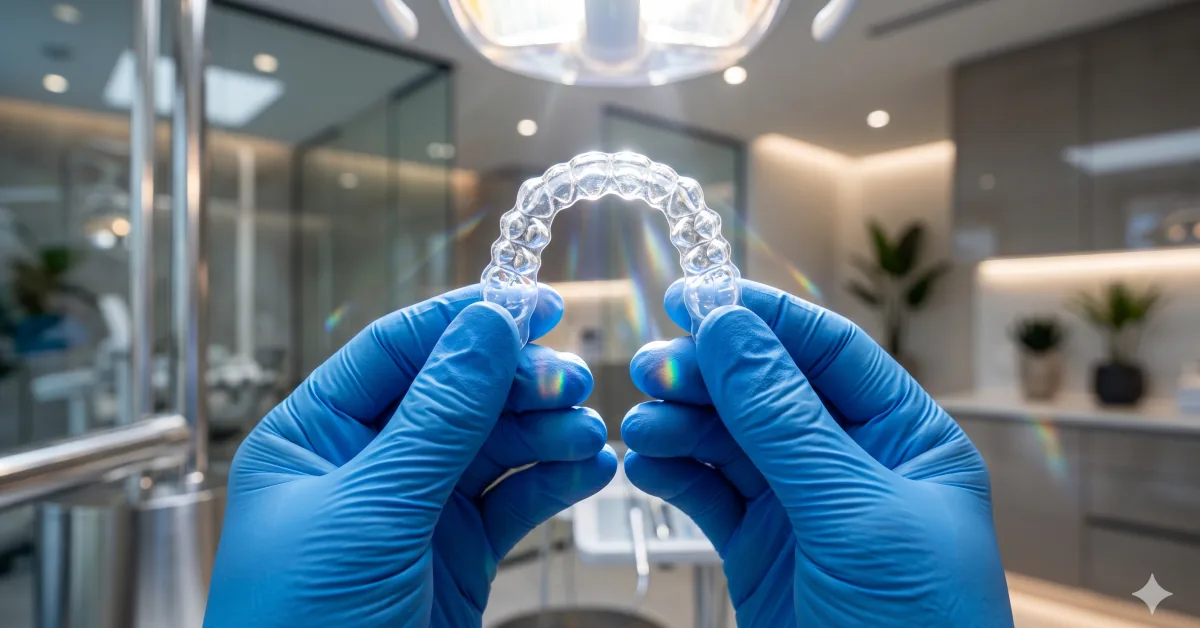
Does Invisalign Hurt? — The Direct Answer
Short answer: there is some discomfort — but far less than most people expect. At Debod Dental Clinic in Argüelles, Madrid, we tell every new patient the same thing on day one: Invisalign does not really "hurt" in the traditional sense. What you feel is pressure. The kind that tells you your teeth are actually moving.
Research published in the Angle Orthodontist and European Journal of Orthodontics shows that 54 to 83% of aligner patients report some degree of discomfort at some point during treatment — but only 8 to 12% describe it as significant pain. On a standard pain scale, the average sits between 2.5 and 3.5 out of 10, peaking in the first 72 hours after fitting a new tray. Compare that with traditional metal braces, where the average is 4.5 to 6 out of 10.
So yes, it can be uncomfortable. For a few days. Then it passes.
There is something important to understand about why the discomfort happens, though — and it tends to surprise people.
Why This Matters for Your Dental Health
Every new aligner tray sits approximately 0.25 to 0.33 mm away from where your teeth currently are. That tiny gap is intentional. It is the force that moves your teeth.
Think of it like the first few days in a new pair of shoes. There is friction and pressure while everything adjusts. Your teeth go through something similar — except the "shoe" changes every one to two weeks.
When a new tray exerts pressure on a tooth, the ligament holding that tooth in its socket triggers a mild inflammatory response. The body releases prostaglandins — the same compounds involved in muscle soreness and headaches — locally, around the tooth root. That is what you are feeling. It is not damage. It is biology doing precisely what it is supposed to do.
The teeth with the most movement programmed into a given tray will feel the most sensitive. Rotations and vertical movements tend to generate a stronger response than straightforward tipping. At Debod Dental Clinic, Dr. Víctor Guerrero — our specialist in invisible orthodontics with over 15 years of experience — plans these movements carefully using digital simulation, keeping the discomfort curve predictable from the first tray to the last.
Now you know what causes it. But what can you actually do about it at home — and when should you be concerned? Both are worth covering properly.
Frequently Asked Questions
Does Invisalign hurt more than braces?
No — and this is one of the most consistent findings in orthodontic research. Patients with traditional metal braces report average pain levels of 4.5 to 6 out of 10; with Invisalign, that drops to 2.5 to 3.5. Brackets can also cause cuts and abrasions on the inside of the cheeks, which aligners generally do not. The discomfort with Invisalign tends to come in predictable waves — a few days of pressure after each new tray — rather than as constant background irritation.
How long does Invisalign discomfort last?
The first 48 to 72 hours after fitting a new tray are typically the most uncomfortable. By day three or four, the pressure settles considerably. Many patients notice less discomfort with each passing tray as they adapt to the sensation. If you are still feeling significant pressure after seven days on a given tray, contact your orthodontist — it can occasionally signal a fitting issue or something worth reviewing before moving to the next stage.
What can I take for Invisalign pain?
Ibuprofen (400–600 mg) is the recommended first option, as it combines analgesic and anti-inflammatory effects. Taking it about an hour before fitting a new tray can reduce the initial response. Paracetamol (1 g) is a solid alternative if ibuprofen is not appropriate for you.
One tip that works particularly well in practice: change your tray at night, just before bed, so the sharpest hours of adjustment happen while you are asleep and not focused on it. Silicone chewies — small foam cylinders you bite on — can also help seat the tray evenly and distribute pressure more uniformly across the teeth. Your orthodontist will usually provide these at your first fitting.
Is pain during Invisalign a sign something has gone wrong?
Usually not. Pressure and mild soreness after a new tray are entirely expected. What does warrant a call to the clinic: discomfort that shows no sign of easing after a full week, a tray that simply will not seat properly no matter how much you bite down, or a sharp edge that is cutting the inside of your cheek or gum tissue. That last issue takes only a few minutes to resolve with a quick polish — no need to interrupt treatment.
How much does Invisalign cost in Madrid?
The honest answer is that it depends on your case. The number of trays needed, the complexity of the movements required, and whether refinements will be necessary at the end all influence the final figure. In Madrid, treatments typically fall between 2,500 and 6,000 euros. At Debod Dental Clinic, your first diagnostic visit is fully included — so you receive a thorough assessment and a realistic picture of what treatment would involve before making any commitment. Financing is available with 0% interest for up to 12 months, and up to 60 months overall with no deposit required.
Does Invisalign discomfort get worse as treatment progresses?
For most patients, it actually improves. The first few trays tend to feel the most unfamiliar, partly because everything is new and partly because initial tooth movements can be more significant. As treatment advances and your teeth approach their final positions, each tray requires less movement — and the pressure is correspondingly lighter. Many patients barely notice the change by the midpoint of treatment.
What Should You Know Before Your First Visit?
A few things worth bearing in mind before you come in for your assessment:
- Bring any questions about pain, wearing time, or your specific situation. There are no silly questions here, and knowing what to expect makes a real difference.
- Not every case is suited to aligners alone. Some movements — particularly complex vertical corrections or significant skeletal discrepancies — may be better addressed with a combined approach. We will tell you honestly which applies to your case.
- Attachments (small composite buttons bonded to specific teeth) are used in most Invisalign treatments to help the aligner grip the tooth and execute precise movements. They can cause minor rubbing initially; orthodontic wax helps.
- You need to wear your aligners for 20 to 22 hours per day. Wearing them less does not reduce discomfort — it prolongs treatment and often requires additional refinement trays at the end.
The most valuable thing before starting any orthodontic treatment is a thorough diagnostic assessment. At Debod Dental Clinic, this is done using an intraoral digital scanner and, where the case calls for it, a 3D CT scan — all processed through Debod Dental Lab, our in-house digital laboratory. That means no outsourcing, no delays, and direct clinical control over every stage of your treatment.
If you want to explore the full treatment process before coming in, our Invisalign and transparent aligners page covers everything in detail.
When Is It Urgent to See a Dentist?
Most Invisalign-related discomfort is self-limiting and manageable at home. But some situations need prompt attention.
Contact the clinic if pain persists beyond seven days without any sign of improvement on a given tray. Also seek advice if you notice deep, throbbing pain or any swelling in the gum or jaw area — that is not typical aligner pressure, and it may indicate a periodontal issue or an unrelated dental problem requiring assessment.
If a tray cracks or breaks, get in touch the same day. Continuing with a broken tray can disrupt the planned movement sequence, causing subsequent trays to fit poorly. Equally, if you misplace a tray and go more than 24 hours without wearing one, your orthodontist can advise whether to go back to the previous tray or move straight to the next.
Gum health during treatment matters more than most people realise. If your gums become red or swollen, or bleed regularly during brushing, flag it promptly. Teeth cannot move predictably through inflamed tissue, and unaddressed gum issues can slow treatment or affect the final result. A dental clean and check-up before starting orthodontic treatment is always a sensible first step.
Why Choose Debod Dental Clinic?
Invisalign is not simply a product you order and wear. The quality of the outcome depends directly on how carefully the case is planned — and on the experience of the orthodontist overseeing every stage.
Dr. Víctor Guerrero has over 15 years of specialist experience in invisible orthodontics and has lectured across Europe and Latin America. In my clinic, every Invisalign case is planned using a full digital workflow: intraoral scan, ClinCheck digital simulation, and 3D CT imaging where indicated. Everything is processed through Debod Dental Lab, our own in-house digital laboratory, so there is no outsourcing, no waiting on external suppliers, and the clinical team retains complete oversight from the first scan to the final tray.
We are located at C. de Ferraz, 24, in Argüelles — a few minutes on foot from Ventura Rodríguez metro station (Line 3) and close to Plaza de España. We are open Monday to Friday, 9:00 to 20:00, and the first diagnostic visit is included at no charge.
Ready to find out whether Invisalign is right for your teeth? Book your first visit and we will give you a clear, honest answer — with no obligation and no surprises.
Telephone: +34 914 47 62 25 | info@deboddentalclinic.com | C. de Ferraz, 24, Argüelles, 28008 Madrid
Frequently asked questions
Frequently asked questions about this topic.
No. Research consistently shows aligner patients report pain levels of around 2.5 to 3.5 out of 10, compared with 4.5 to 6 for metal braces. With Invisalign, discomfort arrives in predictable waves — a few days after each new tray — rather than as constant irritation from wires and brackets.
The first 48 to 72 hours after fitting a new tray are typically the most uncomfortable. By day three or four, the pressure settles considerably. If noticeable discomfort persists beyond seven days on any single tray, let your orthodontist know — it may point to a fitting issue worth reviewing.
Ibuprofen (400–600 mg) is the first-line option: it acts as both a painkiller and an anti-inflammatory. Taking it about an hour before fitting a new tray can reduce the initial response. Paracetamol (1 g) is a reliable alternative if ibuprofen is not suitable for you. Changing your tray at night — just before sleep — means the sharpest hours of adjustment happen while you are resting.
Usually not. Pressure and mild soreness after a new tray are expected and normal. What does warrant a call to your clinic: discomfort that shows no sign of easing after a full week, a tray that will not seat correctly despite biting on chewies, or a sharp edge cutting the inside of your cheek or gum. That last problem takes only a few minutes to fix with a quick polish.
It depends on your case — the number of trays needed, the complexity of the movements, and whether refinements will be required at the end. Treatments in Madrid typically range between 2,500 and 6,000 euros. At Debod Dental Clinic, your first diagnostic visit is fully included, with financing available at 0% interest for up to 12 months and no deposit required.
For most patients, it actually improves. The first few trays tend to feel the most unfamiliar. As treatment advances and your teeth approach their final positions, each tray requires less movement — and the pressure is correspondingly lighter. Many patients barely register it by the midpoint of treatment.
Reviewed by Dr. Víctor Guerrero
Ortodoncia · Ortopedia Dentofacial · COEM Reg. No. 28013382
Last reviewed: 10 August 2026
Informational content reviewed by a registered professional at Debod Dental Clinic. It does not replace a personalised clinical assessment. View specialist profile.

Author
Dr. Víctor Guerrero
Orthodontics · Dentofacial Orthopaedics
Dr. Víctor Guerrero is a leading specialist in orthodontics and dentofacial orthopaedics, recognised for his contributions to the fields of invisible orthodontics and skeletal anchorage. A graduate with honours in Dentistry and Orthodontics…
Meet the team
Did this article raise questions?
Talk directly with our team of specialists. First consultation with no obligation.
Book a consultation